
Deed Types in Lanier County
The Clerk of Superior Court records Lanier County deeds and every related real-property instrument. Labels matter here. A transfer deed and a loan security instrument each carry different legal effects. A lien and a release differ too. Read the recorded document itself before assuming what a short index label means.
| Deed Type | What It Does | Common Use |
|---|---|---|
| Warranty deed | Conveys the stated interest with warranties in the instrument | Conventional sale |
| Quit claim deed | Conveys whatever interest the grantor has, if any | Family transfer or title cleanup |
| Deed from estate | Transfers property through an authorized estate representative | Probate administration |
| Foreclosure or sheriff’s deed | Records a transfer tied to a legal sale process | Completed forced sale |
| Tax sale deed | Records the purchaser’s tax-sale instrument | Delinquent-tax sale |
| Deed of gift | Conveys property without an ordinary sale transaction | Gift transfer |
A security deed secures debt. It is not a deed that sells land. Assignments, cancellations, releases, easements, rights-of-way, court orders, and liens may all sit beside conveyances in the same index. Search every relevant instrument type before drawing conclusions about the recorded chain.
Search Lanier County Deed Parties
The GSCCCA Real Estate Index organizes Lanier County deed records by party. A grantor transfers an interest. A grantee receives it. The chain of title is simply the ordered set of conveyances linking those parties for the same land, with book/page and instrument references pointing to each recorded document.
| Search Field | Portal Choice | Use |
|---|---|---|
| Party Type | All, Grantor, Grantee | Separate transferors and recipients |
| Instrument | All or a named deed, lien, release, easement, and more | Limit the legal record type |
| County | Lanier or a broader selection | Choose the recording jurisdiction |
| Name | Individuals entered last name, first name; entities by legal name | Find indexed parties |
| Date | Optional From and To dates | Narrow a known period |
- Start with the latest known owner as grantee.
- Open the likely deed and match its legal description.
- Record the grantor, date, type, and book/page.
- Search that grantor as a prior grantee.
- Repeat while the property description stays consistent.
Names alone are not enough. Compare land lot, district, acreage, subdivision or plat reference, and road or waterway calls instead. Trusts, estates, companies, initials, and name changes can break an otherwise sound name-only search.
Lanier County Deed Index Dates
The county-specific Lanier good-through page lists coverage from January 1, 1986 through September 2, 2026. General GSCCCA pages state other central-system dates. For Lanier deed search planning, trust the county result. It reports index status only. It is not a promise that every image in every year is online.
View the official Lanier index status straight from the source.
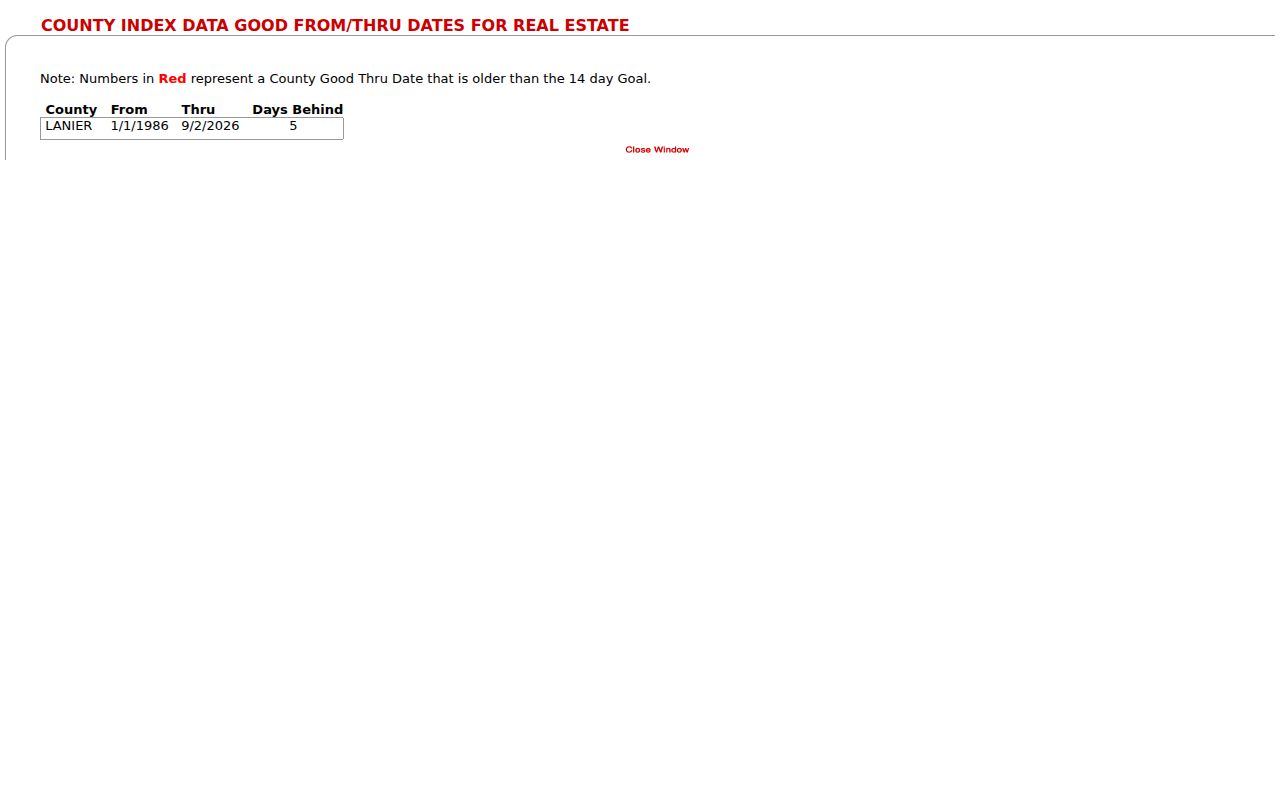
That county page answers the coverage-date question. It cannot answer whether a particular book, page, or image is retrievable. Only an actual instrument search tests that. Note: Never substitute the central marketing date for Lanier's county-specific status or treat the ending date as a permanent promise.
Read Lanier County Deed Results
Official GSCCCA descriptions say a result can lead to instrument date, parties, county, indexed property or subdivision data, and book/page. It can also show instrument type, consideration or PT-61 data, and image controls when an image exists. The result layout can vary. The recorded instrument always controls. A consideration field is not a current appraisal. A court filing does not mean title changed. Title changes only when a later deed or order completed that result. A foreclosure notice, lis pendens, tax delinquency, and foreclosure deed each mark a different stage. Open the live GSCCCA name form to begin a Lanier County deed search. Search by grantor or grantee.
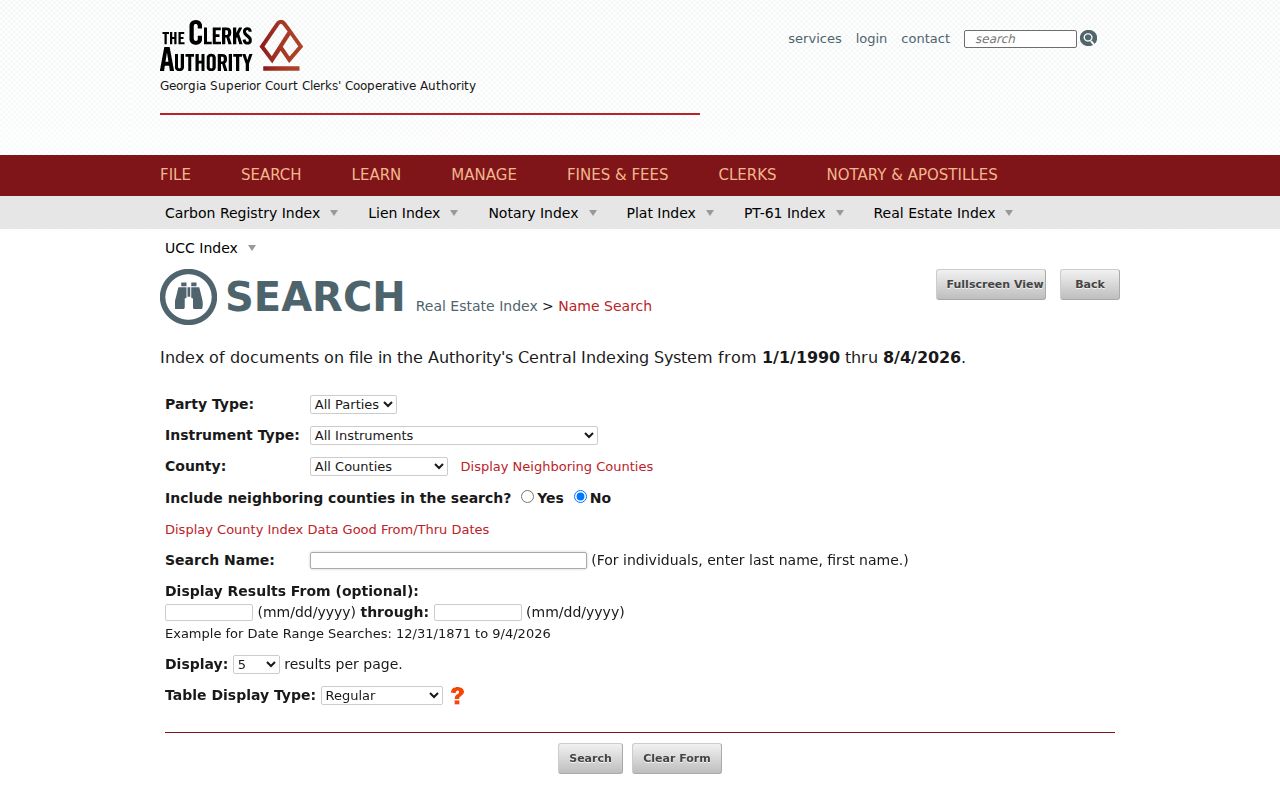
The form displays the available search controls, and no person-specific result is pictured or implied.
Separate Lanier County Deeds From Liens
A clean deed search does not answer every encumbrance question. The GSCCCA Lien Index carries its own controls. These cover party, instrument, county, neighboring-county, date, row, and display settings. Its party choices distinguish the direct party from the reverse party. The direct party is usually the debtor. The reverse party is usually the claimant. Instrument labels include Fi Fa, federal tax lien, and mechanics and materialmens lien. Lis pendens, levy, assignment, cancellation, release, order, and notice also appear as labels.
Search the owner of record and prior owners under name variants. Then pair each apparent lien with its release, cancellation, assignment, or later order. A security deed and its cancellation may sit in the Real Estate Index. A judgment lien, by contrast, can lead to the General Execution Docket. Under the local Magistrate procedure, a Writ of Fi Fa creates a lien on a judgment debtor's property. The Superior Court clerk records it. It does not itself convey the property.
For a property lawsuit, Georgia Courts E-Access directs Lanier Superior Court users to PeachCourt. A docket entry may mention quiet title, partition, foreclosure, boundary relief, or an injunction. Search the parties in that case. Then request the actual pleading, order, or disposition from the clerk. A filed case may be dismissed or settled without the transfer a short docket label suggests.
Work document by document: deed, security deed, lien, release, court order, and later conveyance. Keep the recording date and book/page for each one. Same-name matches and notices against a party can concern other land. The legal description remains the check that holds the Lanier County deed chain together.
Lanier County Plat and Deed Clues
A deed's legal description often hides its own trail. It may cite a plat, easement, or right-of-way. That record has to be searched separately. The GSCCCA Plat Index handles that chase, with controls for name, instrument, county, district, land lot, and date, plus a book and page form. Image coverage differs by county, so check what Lanier County actually returns before counting on an image.
One 2025 Lanier County bid exhibit adds unusually firm leads. It cites a survey recorded on June 2, 2025 in Plat Book CABB at page 6P. Plat Book I at page 463 holds an older item. Georgia Power rights-of-way appear in Deed Book 19 page 79 from 1958 and Deed Book 24 page 583 from 1971. These citations are leads, not proof of a named subdivision or any verdict on the affected parcel. Pull each instrument by book and page, compare the legal description, and decide whether it is a survey, replat, boundary, easement, or public-land transaction.
Older Lanier County Deed Books
Older Lanier County deed records live in the courthouse. When the online index runs out, take a known book and page, a party name, and the legal description to the Clerk of Superior Court. GSCCCA reports free public search terminals in each Superior Court clerk office. The clerk's vault and book indexes are the direct route.
Lanier County dates to August 7, 1920. It was carved from parts of Berrien, Clinch, and Lowndes. So a conveyance before that date may sit under whichever predecessor county held the land then. Search by land lot, district, acreage, road, river, lake, and plat references. Do not force a modern street address backward.
The Georgia Archives tax-record guidance explains statewide tax-digest holdings. Its county-card collection helps locate microfilmed county material. A digest can surface a landholder lead, but it never replaces the deed chain.
Monitor New Lanier County Filings
Monitoring fills a gap the historic index leaves open. The free GSCCCA Filing Activity Notification System, known as FANS, watches for new filings tied to property you register. An enrolled owner gets notified of later activity. Email and one-time-code phone options appear at login. FANS has real limits. It does not repair the historic chain, block a filing, or certify fraud. Its terms restrict the service to owned or authorized property. The terms also bar harassment and unrelated research uses. Treat an alert as a cue to pull the new instrument. Call the proper office if it looks unfamiliar.
Note: A monitoring alert is not evidence that an instrument is false. It is also not evidence that legal title changed.
Obtain a Lanier County Deed Copy
Start with whatever image is already online. If access is account-gated or the image is missing, gather the county, book and page, instrument type, party names, and recording date, then take that detail to the public courthouse terminal and ask the Clerk of Superior Court for a plain or certified copy. Lanier County publishes no local copy-price schedule. Confirm the current fee before ordering. Mail and in-person requests work best when they identify one record as closely as possible.
Georgia Open Records Act requests can seek existing administrative records. For a known deed, the clerk's route is cleaner. Under state guidance, agencies generally respond within three business days or explain the timetable, cost, or any exemption. A probate file can explain why an executor acted. The conveyance itself still belongs in the Superior Clerk and GSCCCA chain. A Fi Fa on the General Execution Docket is a lien lead. It is not a deed transfer.
Recorded, not guaranteed. Lanier County deed records show what reached the public record. They are not a title opinion, and unrecorded interests or unresolved legal issues may remain.
Certified and plain copies serve different needs. If certification is required, ask the receiving agency, attorney, lender, or court before paying. Order from the official custodian, not an index screen. Keep the clerk's certification page with the full instrument and every exhibit, rider, legal description, and recording stamp.