
Fields in Lanier County Tax Records
Lanier County property tax records split cleanly between assessment fields and billing fields. The Board of Tax Assessors keeps the parcel card. It also holds owner and mailing data, classification, exemptions, sales, and valuation. The Tax Commissioner takes it from there. That office handles the amount billed, collection, and any delinquency question you have.
| Field | What It Shows | Where |
|---|---|---|
| Fair market value | Assessor’s estimate of full value for the roll | qPublic parcel card |
| Assessed value | Georgia taxable assessment base before applicable exemptions | Tax Assessor |
| Land, improvement, accessory | Components behind the value total | qPublic valuation rows |
| Exemption | Relief recorded for an eligible parcel or owner | Assessor record |
| Millage and district | Rate and jurisdiction information used in the calculation | Parcel record and tax administration |
| Bill and payment | Charge, collection, and current account details | Tax Commissioner and Government Window |
Watch the sales fields closely. A recorded sale price can differ from the assessor's fair market value, and both can differ from the assessed value that actually drives the tax. The deed proves a transfer happened. The bill never does.
Lanier County Assessment and Millage
Georgia generally assesses taxable property at 40 percent of fair market value. Exemptions come off first. Then the millage rate applies to what remains. One mill equals one dollar of tax per thousand dollars of taxable assessed value, and a real bill often stacks several taxing components on top of each other. Skip the countywide shortcut and read the parcel's district off the current bill instead.
- Fair market value
- The assessor’s full-value estimate for tax administration.
- Assessed value
- The portion of fair market value placed on the taxable assessment base under Georgia rules.
- Millage
- The tax rate expressed in dollars per thousand dollars of taxable assessed value.
- Homestead exemption
- Qualified relief that reduces the taxable base under applicable state or local law.
- Tax lien
- A legal claim tied to unpaid tax, distinct from the original bill.
For official answers on returns, exemptions, and payment rules, the Georgia Department of Revenue's Lanier tax facts page is the place to verify. It notes that Lanier has no local homestead exemption, though statewide programs, including qualifying disabled-veteran relief, may still apply. The assessor confirms eligibility in every case.
Search Lanier County Assessment Fields
The Lanier qPublic portal is the public entry point for parcel assessment data. A tax-focused result there can carry the parcel number, owner of record, values, and exemption entries. It shows what the assessor's records hold for the account.
| Portal Item | Observed Content | Tax Use |
|---|---|---|
| Parcel identity | Number, location, legal description, acres | Match the correct account |
| Owner | Name and separate mailing address | Read the assessment roll |
| District | Tax district and millage rate | Check the rate context |
| Exemption | Homestead field or status | See whether relief is recorded |
| Valuation | Prior/current rows; land, improvement, accessory, total | Audit value components |
| Sales | Date, price, reason, grantor, grantee, book/page | Find evidence, not a substitute appraisal |
Search by address or owner where offered, open the parcel, and copy its number exactly. Lanier public records show identifiers in both compact and spaced forms, sometimes with leading zeroes or suffix letters. That exact string is the safest link to the Tax Commissioner's billing account.
Look Up a Lanier County Tax Bill
The Government Window portal is the county-linked route for paying a Lanier County tax bill online. It does not replace qPublic's assessment record. Check the live account for exact bill fields, delinquency display, installment rules, and any service fee before relying on a figure.
- Find the parcel and exact identifier in qPublic.
- Open the Tax Commissioner’s county-linked payment route.
- Match the parcel or bill account before reading the charge.
- Compare exemptions and value back to the assessor record.
- Call the Tax Commissioner for delinquency or sale-status confirmation.
The Tax Commissioner's office sits at 100 Main Street in Lakeland and answers at 229-482-3795. Collection is its role. Appraised value and parcel facts belong to the Board of Tax Assessors at 229-482-2090. Exemption decisions rest with that board too.
Note: A payment processor may add a service charge, so confirm the total and method before completing an online payment.
Lanier County’s 2025 Tax Digest
Lanier County posted its official 2025 property-tax-digest notice on October 13, 2025. The attachment is an image notice, not a searchable parcel roll. Use qPublic for parcel-level assessment work. Go to the Tax Commissioner for the bill itself.
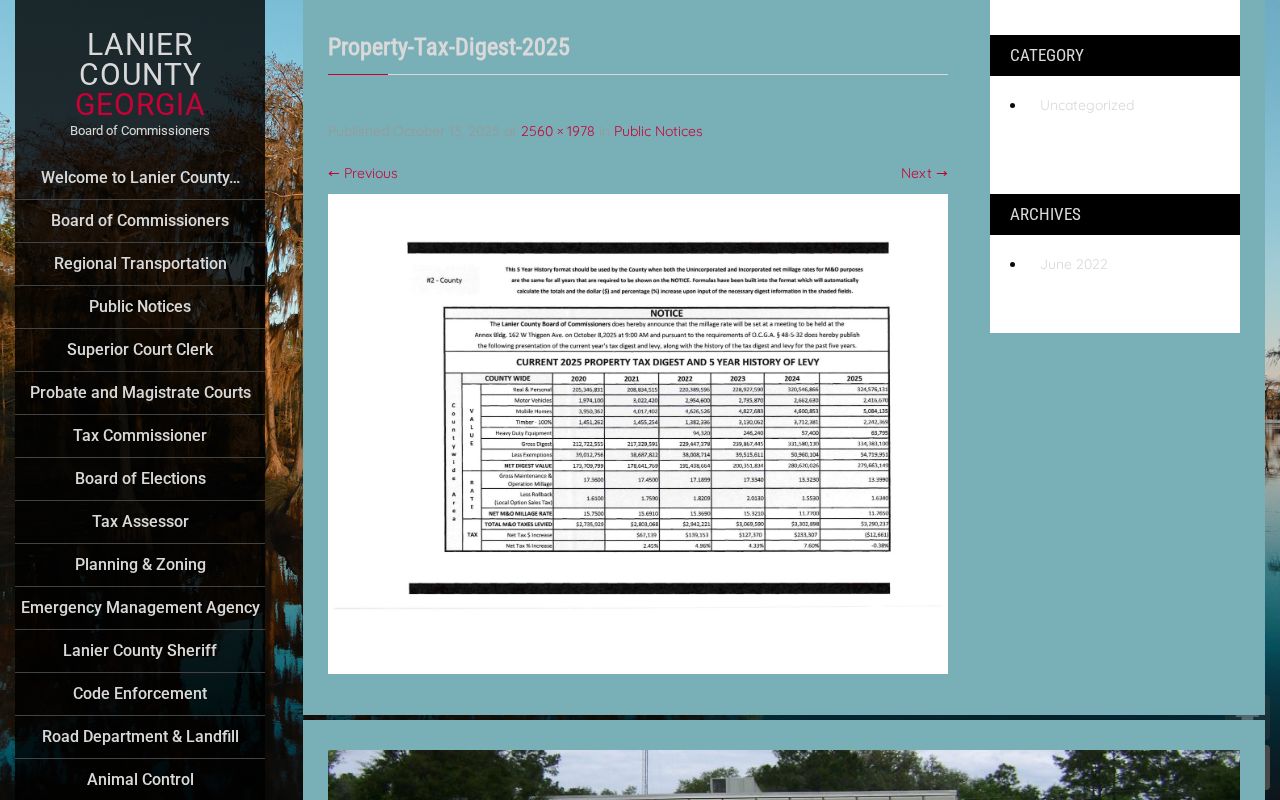
The notice documents a dated county action and nothing more. It will not reveal one owner's current value, tax balance, exemption, or payment status. That distinction matters. A digest summarizes the tax base for public administration. A parcel card is the account-level assessment record. A tax bill is the collection document.
Lanier County Revaluation History
qPublic still carries a legacy notice naming 2007 as the last full revaluation. It was tied to a compliance project after sales-to-assessment comparisons fell out of line. Treat that text as history only. It says nothing about the current revaluation year or a parcel's present value. Read the year on the parcel valuation row instead, along with any current assessment notice. When a value moves, compare the components. Look at land, improvement, and accessory figures rather than trusting the total alone. A review can follow an ownership change, a permit, or a return of value. Fire damage, demolition, or an appeal under the assessor's site-visit notice can also trigger one. Context explains most jumps.
Four different numbers. Assessor fair market value, assessed value, recorded sale price, and the amount billed are distinct Lanier County property tax concepts.
Verify Lanier County Tax Exemptions
An exemption field on a qPublic card proves relief was recorded, nothing more. It does not show present occupancy or title. Check the Georgia DOR Lanier facts page for state programs and county rules. Then confirm eligibility and filing requirements with the Tax Assessor.
Never infer an exemption from age, mailing address, family relationship, or an old deed. Programs carry legal tests and supporting-document rules. A trust, an estate, agricultural classification, or conservation-use entry may need a closer look. A basic parcel screen gives less than these cases demand.
Keep the filed form, assessment notice, assessor response, and parcel card together. Together they show what was requested. They show what was granted and which tax year took the effect.
Lanier County Delinquency and Tax Sales
Lanier County publishes no online list of delinquent taxes and no web archive of tax-sale notices. Skip the web hunt. The Tax Commissioner and the county's public notices are the right route. Ask about a specific parcel and tax year. A missing search result never proves a bill was paid.
Know the stages. A delinquent bill and a tax lien are each separate steps in Lanier County property records. So are a sale notice, the sale itself, and a recorded tax-sale deed. The GSCCCA Real Estate Index lists a Tax Sale Deed instrument type. The lien index points to recorded claims and releases. A complete property search reads the tax account, the public notice, any lien or case entry, and every later deed together.
One local Magistrate procedure is worth knowing. A Writ of Fi Fa creates a lien on a judgment debtor's property. It is recorded by the Superior Clerk on the General Execution Docket. That record alone does not show the tax account was sold. It also does not show that the owner of record changed.
Contest a Lanier County Assessment
Start with the current assessment notice. It controls the filing window and the method. Lanier County publishes no fixed appeal deadline you can safely rely on from year to year. Confirm the current calendar and form with the Board of Tax Assessors instead of trusting a prior year's date.
Strong evidence helps. Bring the parcel card, photographs, a survey, or corrections to land or improvement facts. Comparable sales, repair information, and the assessor's calculation also carry weight. Separate factual errors from plain disagreement over value. Keep proof of timely filing plus every response you receive.
Appeal window. File by the deadline printed on the current notice and verify receipt with the Lanier County Board of Tax Assessors. A generic calendar cannot preserve appeal rights.
Georgia's Open Records Act can help you obtain existing public records used in an assessment review. Agencies generally must respond within three business days. They can instead give a written timetable, cost, or exemption explanation, but the law does not extend your appeal deadline.
Request Lanier County Tax Records Offline
Online screens are not the only option. The Board of Tax Assessors sits at 56 W Main Street, Suite 2, in Lakeland. Its phone line is 229-482-2090. Ask that office for an existing parcel card, value history, exemption record, or assessment notice. The Tax Commissioner handles current bill, collection, receipt, and delinquency questions at 229-482-3795.
Be specific in any request. Give the parcel number, the situs address, and the owner name shown on the tax roll. Also give the tax year and the exact record sought. If a tax issue produced a recorded Fi Fa, lien, release, tax-sale deed, or court filing, take the party name and parcel description to the Superior Court clerk and GSCCCA. Those deed records explain legal steps that sit outside the bill itself.
Older research takes a different path. The Georgia Archives Virtual Vault holds a tax-digest collection with county finding aids. Statewide digest holdings reach back before Lanier County existed. Land now in Lanier County may appear in Berrien, Clinch, or Lowndes records before 1920. Search whichever county held the land in the year you are studying.
Read historic digests with care. An entry can show a taxpayer and a taxable property category for a year. It cannot prove a modern parcel boundary, current ownership, or an unpaid balance. Link the historic name to deed books and land descriptions. Do that before treating it as the same property.