
Identify a Lanier Property Owner
Two sources carry the weight. Lanier's qPublic page supplies the tax-roll name, while GSCCCA supplies the recorded conveyance. Match both to one parcel and one party before trusting an answer.
- Search the property address through the Lanier qPublic assessor entry.
- Save the Owner field, mailing address, parcel number, Location Address, legal description, and sale book/page.
- Search that name as grantee in the GSCCCA Real Estate Index, with LANIER selected.
- Open the newest relevant deed and match its land description to the parcel card. Check a later deed if the same party appears as grantor.
This route stays inside the public record. It is not a full portal tour. The current Lanier County property owner record adds detail on roll fields and timing.
Where Lanier Ownership Is Shown
No Lanier County screen settles title on its own. The roll exists for assessment. The deed index reports recorded instruments, and the mapped parcel confirms you are comparing the right tract, so read them together.
| Ownership source | What it gives | Currency check |
|---|---|---|
| qPublic assessment roll | Owner, mailing address, situs, parcel, sale and value fields | May lag a newly recorded sale |
| GSCCCA deed index | Grantor, grantee, instrument, date, and book/page | Use the newest deed for the matched land |
| qPublic View Map | Mapped relationship between card and parcel | Reference only, not title or survey proof |
| Clerk counter or terminal | Recorded books, index help, and available copies | Fallback when the web or image fails |
The Clerk of Superior Court records deeds. The Tax Assessor keeps the parcel roll. Calling either office's product "the ownership record" hides that split. Online access is only one channel. qPublic is the natural first stop. GSCCCA offers an index with account-based image functions. A public terminal or the Clerk counter can reach books the web does not. The Tax Assessor can explain a roll mismatch. A written request can seek a defined existing record.
Read Lanier's qPublic Owner Field
qPublic splits Owner and mailing address from Location Address. A parcel result also shows the parcel number, legal description, land lot and district, acres, homestead details, sales, valuation, and a map view. That separates the taxpayer from the site. Timing matters. The assessor publishes no fixed refresh date, and its notice only says reviews cover property that changed ownership in the prior twelve months. A recorded deed can land before the new grantee replaces the old tax-roll name. The official qPublic landing page is Lanier County's assessment entry. The live search application runs from there. Deed confirmation still follows at GSCCCA.
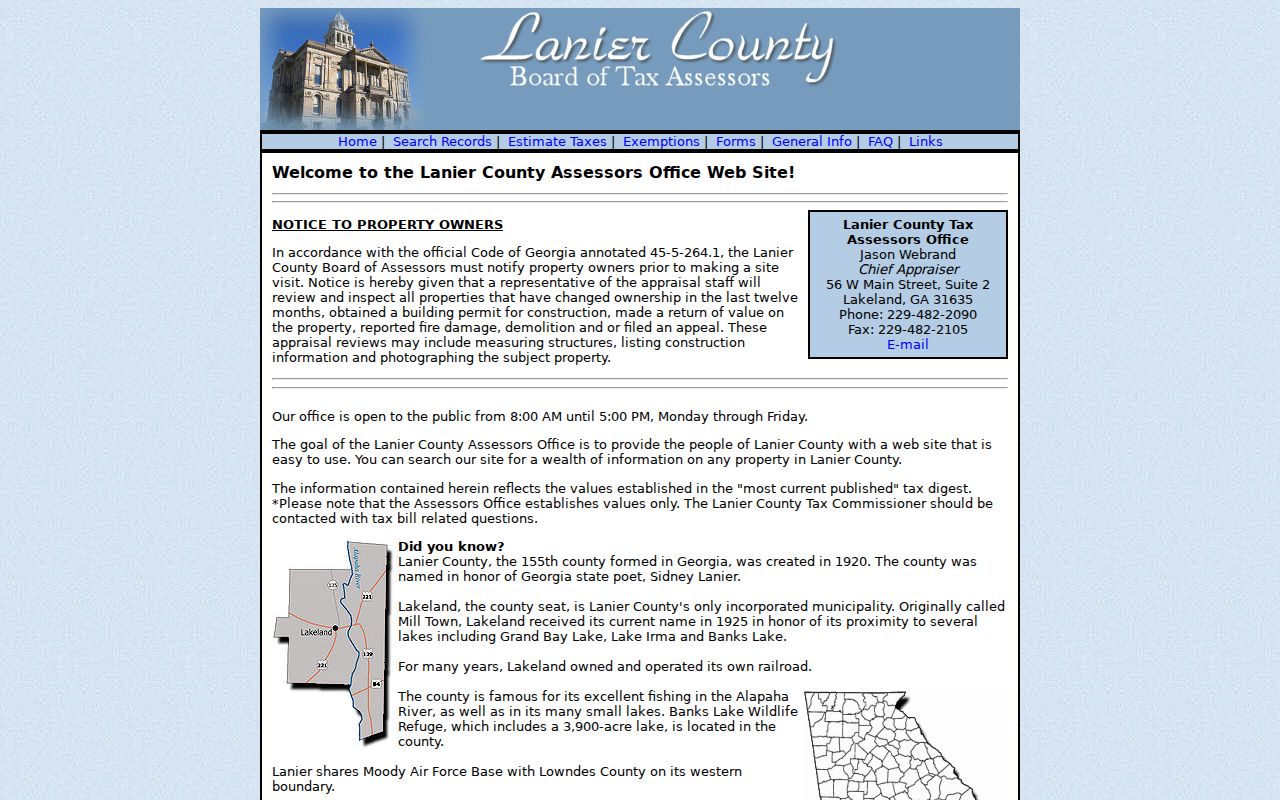
The link documents the official route. An actual owner answer still needs a parcel result and a deed check at GSCCCA.
Confirm Who Owns With Deeds
GSCCCA's name search accepts a party name, county, party type, instrument type, and a date range. Follow its format: last name, then first. Short name searches require date limits. Select Grantee to find an acquisition, then run the same name as Grantor to see whether a later conveyance moved the parcel away. Record the exact party spelling, instrument type, filing date, and book/page before chasing the image. A shared name proves nothing. Match the legal description, land lot, district, acreage, or plat citation instead. The recorded instrument may cover several parcels. Confirm the subject tract is included rather than trusting the first result. Lanier's county index runs from January 1, 1986 through September 2, 2026, though image access varies inside that range. Use the Clerk's books for anything earlier. If the trail passes Lanier's formation in 1920, use the legal description to choose Berrien, Clinch, or Lowndes predecessor records. Georgia Archives tax digests offer clues. A digest name is a lead, not deed proof.
Trace Lanier Company Owners
A roll or deed may name an entity. Keep the legal name exactly as recorded. For a Georgia entity, the Secretary of State Business Search supports Business Name, Control Number, Registered Agent Name, Officer Name, and Designated Agent Name modes. Starts With, Contains, and Exact Match all help. An entity filing can show status, registered office, agent, officers, and filing history. It does not prove personal ownership of the land. A trust may call for the deed, a later trust instrument, a probate record, or legal help. Probate can explain the executor or administrator on an estate deed. The recorded deed still anchors the chain of title. Try name variants before rejecting a match. An entity may appear with punctuation, an abbreviation, or an older legal name. Compare the control number and the deed. The deed names the grantee entity, and the corporate filing reports only its registration data.
Resolve Lanier Same-Name Results
Names repeat, initials shift, and married or estate names change. Let the legal description control the comparison. Check the location, parcel key, land lot and district, acreage, prior grantor, and plat or book/page. That keeps the deed on the right tract.
- Owner of record
- The party shown on the current assessment roll.
- Grantee
- The party receiving an interest in a recorded deed.
- Title
- The legal ownership interest, which a simple index or tax-roll name does not fully prove.
- Situs address
- The property's physical location, distinct from the owner's mailing address.
Lanier Owners Can Monitor Filings
Lanier County owners have a free way to watch for future filings. GSCCCA's Filing Activity Notification System, called FANS, sends an authorized owner alerts. A new filing under an enrolled name triggers a notice. It looks ahead only. It cannot search the past chain, and it cannot block a document from being recorded. Use Lanier County property records to see who owns a parcel first. FANS then adds a self-monitoring layer worth having. New name activity may still merit a call to the Clerk or a title professional. Treat it as an early warning. It is no substitute for title insurance or a legal ownership opinion.
Respect Lanier Address Differences
A mailing address tells you where the tax bill goes. Nothing more. It is not proof that anyone lives there. Programs like Georgia Safe at Home and VoteSafe can lawfully shield residence details. So the deed, the tax roll, and the voter file may show three different addresses for the same Lanier County parcel. Never use a public field to defeat a protected address. If you must contact someone about a real property issue, tie it to the record. Use a lawful published channel. Do not assemble a personal profile from unrelated sources. Public availability does not authorize threats, repeated unwanted contact, or harassment.
Limits of a Lanier Owner Lookup
An assessor search names the taxpayer on the roll. A deed records the grantee for the described land. Neither one alone finds unrecorded claims or repairs probate defects. It does not test every lien or easement. It also does not prove the named owner actually occupies the site. For a purchase, an estate, a boundary fight, or contested ownership, bring in a title examiner. You can also bring in a Georgia attorney. They can search the full chain and weigh each instrument. The public lookup still gives a solid first answer to who owns the land in Lanier County. Just keep its limits in view. Context fields deserve care too. A homestead entry, a utility account, a map label, or a business filing can support the picture. None of them displaces the match between deed and parcel number. Remember that the tax bill is not a deed. It shows collection against the assessed parcel, while the deed records the transfer itself. Confusing the two turns a useful clue into an unsupported claim. Read the fine print on the latest instrument before declaring an owner. Corrective deeds, quitclaims, estate transfers, foreclosures, sheriff sales, and tax sales all carry terms worth checking. Check them alongside related filings. A lien or security deed does not convey the same interest as a deed. Complex title and redemption questions belong with a professional.
Use records lawfully. A Lanier owner name is not a title search. An LLC or trust may hold title, and no result may be used to harass or harm anyone.
Document the Lanier Owner Match
Write down what settles the question. The roll year, the parcel number, the deed filing date, and the book and page where the instrument lives all belong in your notes. If the assessor's tax roll shows one owner of record and the deed records at the Clerk's office show another, keep both results with their dates. Then ask the assessor when its roll updates and let the Clerk confirm the recorded deed. Those few details make any later recheck easy. An undated screenshot proves nothing.